Friday, October 8, 2010

I'd like to make a Statement

Art is so universal because it doesn't need words to convey the message. When most people were illiterate, churches would hire artists to illuminate their alter pieces with depictions of doctrine. The art did the talking. So- what is the point of an artists statement? Why attach words to something that should speak for itself?

An artist's statement is not instructions on how people should interpret the painting. Rather, it additional information. It's a window into the artist's thought process, why he chose that media, why he chose the topic, how he went about doing it. Hopefully, when someone looks at your art it inspires questions, and hopefully an artists statement answers some of them. Artists statements are essential to teach in a classroom. It's one thing for kids to produce art. It's another to ask them to express why and how they did it. Students need to understand that art should speak for itself, but that an artists statement has a purpose.

When I go to a gallery, I seldom look at the artists statement plaque next to it unless a piece really intrigues me. I usually have questions about it. To teach students how to understand and write artists statements, I'd pull out some art that either have artists statements, or some of my own art that I've written statements for, and have them ask questions. This would get them engaged with a piece and curious about it. Then we could read the artists statement and see if any of the questions were answered. A teacher could easily guide the discussion and give examples of good questions to ask about the art.

After you've questioned art and read examples of artist statements, you can move on to how to write your own. I'd write questions on the board including the ones you asked when looking at the other art to help them brainstorm. In her lesson plan, teacher Pam Stephens gives sample questions such as:
  • What are your personal art values or aesthetic?
  • How are your personal art values or aesthetic seen in your artwork?
  • What do you like best about the finished product?
  • Describe the medium you use.
  • Describe your style.
  • Describe a theme that runs through your work.
  • Why did you decide to become an artist?
  • What do you like best about making art?
  • What has influenced your work (Travel? Other artists? Family? Culture?) How does your work reflect this influence? (Incredible)
  • what did you enjoy about creating this piece?
  • What were some difficulties you had and how did you work through them?
  • What is your favorite tool? Why?
  • Why did you create this piece?
In the book ”How to Write an Artist's Statement” by Melissa Wotherspoon, she poses these questions:

How does the creation of art make you feel? What emotions do you wish to convey?

If the statement refers to a specific piece, why did you choose to represent this piece in this way? What do you call the piece and why? What materials did you use? What are the dimensions of the piece? (This can also apply to a series of works, like for our show)

What inspires you? How are your inspirations expressed in your work?

What message are you trying to convey to the viewer?

How much time is spent creating your pieces?

How is your work a reflection of you?

What is your vision/philosophy?

What are your techniques and style and how do these relate to the medium?

How do your techniques and style relate to your vision/philosophy?

Why do you create art and what does it mean to you?(How to)

All these questions are great, but you as the teacher should decide on the best ones to use as examples. The maturity of your students should guide you in choosing appropriate questions. For younger grades, have them answer around three, for older kids more depth should be expected.

Christopher Bruce, a secondary art teacher, had his students interview each other about their art (Monthly). I think that would be another great exercise to help the students see what other people want to know about their pieces.

Artist Statements do have a point and they're worth teaching. I don't remember learning about them in school, and I don't see them really mentioned in our textbook. I'm glad I got to research them because I find it important for students to formulate and express and write about their art.

Sources:
Incredible art lessons http://www.princetonol.com/groups/iad/Files/Pam-Artist.htm
http://blogs.myspace.com/index.cfm?fuseaction=blog.view&friendId=439570646&blogId=488273481#ixzz11sqfLRgq
Monthly mentor http://naea.typepad.com/naea/2010/07/how-does-writing-about-art-help-students-in-the-assessment-process.html

Monday, October 4, 2010

Stop bugging me!


For this project we created a bug! First we observed bugs, then researched them and drew them, then made our own bug. We even got to act out how our bug interacts with other bugs. After drawing our new bug, we cut out and layered construction paper to make a "plate" to print. We used the plate to do rubbings with crayons and an actual print.
I wanted mine to be a little different, so I tried to do a more ambiguous rendition of my bug and print a collage of them. I liked this idea in theory, but I kind of wish I'd just done one big bug in retrospect. I hope to use this in the future with a class, but I'd probably just do the crayon rubbings with younger grades.

Wednesday, September 29, 2010

Bamboo and "Chinese" Writing


In class, we learned techniques to paint bamboo on rice paper. I like how mine turned out once I got the hang of it- but I had a couple that were disastrous- mainly because there was a shortage of black paint. But it was fun to learn different ways to handle a paintbrush, and even more fun, I think to design the Chinese- like writing out of English letters. It took me a long time arrange 7 letters then decide on which one I liked best, but it was worth it- I really like it! I would definitely use this in a classroom.

Friday, September 24, 2010

Let's Assess the Situation

Art teacher Linda Carson stated "Grading art isn't subjective, it's qualitative. Instead of tallying the number of answers you get right, an art teacher assesses the qualities of the work, such as your choice of subject, handling of media, and control of the composition. That means, incidentally, that it's harder to grade art than a spelling test, an arithmetic quiz, or a multiple choice history exam. In general, it's hard to grade any assignment where the answers don't fit neatly on a computer card."

I completely agree. A teacher has to know his stuff to slap a grade on something a student's put her heart and soul into. In thinking about being an art teacher, I'm actually terrified of grading students. Grades were super important to me and stressed me out. I want art class to be something that's not stressful for my students, but that's hard to do while still maintaining high-quality expectations. This is what I had in mind when I thought of my formative and summative evaluation strategies-

Formative:
I think it's very important to be encouraging throughout the formative process, guiding a student through their piece not in a constrictive way, but with open suggestions and an attitude of helpfulness. This way you can make sure they're going in the right direction and fulfilling the assignment requirements. Ask questions about the art to steer them in a good direction, and also be very accessable so they can ask you, the teacher questions.

Give adequate time for them to complete the project. It's important to be lenient when it comes to art. I'd have them turn it in, but they can always keep working on it if they want a higher grade. I'd give final grades after viewing their entire portfolios.

Have a healthy mix of exercises and projects. You may not want to hang up a color wheel, but it's important to know that kids understand colors, and a color wheel's the best way to do that.

Finally, it's the teachers job to keep the class under control. My last formative strategy is to remove distractions, and pay attention to the effort the students are putting in. You can usually tell when someone is trying hard and when they're goofing off, and it almost always reflects in their craftsmanship.

Summative:

At the beginning of the year, I'd ask the students to do a picture of whatever they wanted with no instruction, just to show me what they can do, then I know what level their starting out on. What a great summation technique to have a visual comparison of how they improved when they compare that to their final pieces.

I find it really hard and time consuming to self analyze, but it's still helpful. I think they should tell me what grade they deserve and why before I determine their final grade.

I'd use a rubric for parents' sakes and probably write a note too. See http://www.goshen.edu/art/ed/rubric3.html - it had some great criteria.

Rather than having them take assessments I would have them keep a sketchbook. I'd give them a little bit of time in class, but they could always make it up by doing a sketch at home. At the end, they'd turn in their sketches. I think this is a vital way to tell if a student is learning how to perceive shapes and growing as an artist.

In the book, it mentioned a summative evaluation method that I actually saw my teacher use. "From the following list of what we did in art this year, mark those activities that you really liked, or from which you learned a lot. Write if there was anything about the activity that made it especially good." I think this would help SO much in choosing what things to keep in the curriculum.

I gave a few more than 6, but I find all these practices important. It's hard to grade art, and it was brought up in class- what if a student produces a beautiful piece that doesn't follow the instructions? I think, if you're doing your job as a teacher, it wouldn't even come to that. If students are working closely with an art mentor, it's unlikely that they would go in the completely wrong direction. However, if it came to that, I think you should doc a good chunk of points. There of course should be some given for artistic merit, craftsmanship, creativity, etc, but until they turn in a piece fitting the criteria, full points should not be given.

In short, if students have everything turned in, make good use of class time, and you can tell puts effort into their work, they deserve high marks.


http://lindateachesart.typepad.com/linda_teaches_art/2008/09/how-to-you-grade-art-assignments.html
Text
http://www.suite101.com/content/teacher-strategies-for-improving-instruction-a202797
www.goshen.edu/art/ed/rubric3.html

Tuesday, September 21, 2010

Line upon line


Here are some lovely still life contour line drawings made with a view finder. I threw in one I did of my apartment last year cause it's my favorite contour line drawing- and it's actually because of the only part that's not just a line! I love the soup can. It's on a really clear emphasis and I just love the juxtaposition of all the lines, then a super detailed can of soup, which is somewhat iconic because of Andy Warhol.
It's fun to be in 3-D design because I'm beginning to see how strong lines are important in every media.

Friday, September 17, 2010

A critical subject...

How should an elementary critique be run? Critiques can be harsh in college. I had a professor tell me how he had his peice ripped up in front of the entire class during a critique. Thankfully, I've never had a critique that harsh.
Critiques for elementary students are a completely different ball game. The main purpose of an art class for younger grades is to promote a love and appreciation of art- not scare them away with feelings of inadequacy. On the Kennedy Center's ArtsEdge website, it emphasizes that the teacher should lead the critique in a positive direction, prompting students with the right questions to help them hone their persuasive, oral and writing, information-gathering, and justification skills.
I have had really positive experiences with critiques and have gathered what I thought was constructive. My professor would usually ask the artist what he thought of his piece, to describe it to the class, and at the end, asked the artist to identify things he would change, wrapping up with constructive criticism. For elementary students, I don't think any realm of negativity should exist in the critique, but I think the aspect of the artist presenting the peice is an important component of a successful critique. Shirley Ende-Saxe, a teacher at an elementary in Ohio, wrote of how she had the artist run the critique, giving them the freedom to call on classmates once the critique was opened for comments.
I once had to judge artwork of the Reflections Contest, a PTA art competition. It was one of the hardest things! Children are so creative, but sometimes their motor skills aren't completely there, and it's hard to judge the level of effort and craftsmanship. The reason I bring this up is because I had to decide which piece was better than another, comparing them side by side. This is NOT the mindset we should be in at a critique. It is so important to avoid comparisons; rather, we should completely focus on each piece one at a time.
As an art teacher, I plan to post up the students' art and go through them piece by piece. I'd let the student tell about it, then open it up for positive comments and let the student call on them (I really liked that idea!). I'd prompt questions if necessary to emphasize judgment, description, analysis, and interpretation, then wrap up each one with my comments. This way, I feel like I could keep control of the class, boost the confidence of each student, and help students learn how to critique.
In FranCoise Barbe-Gall 's book How to Talk to Children about Art, he writes that we need to educate kids about paintings by artists as diverse as Botticelli, Vermeer, Degas, Chagall, and Pollack. In addition to critiquing each other's art in an elementary class, I think teachers should consider choosing a piece of fine art each day for the students to write about, then talk about it once they've thought through their responses. I think analyzing great artwork would greatly benefit the discussions in classroom critiques.
If a teacher can initiate and maintain a positive atmosphere for students to think and talk about their artwork, guided by questions and inspired by analyzing recognized artworks, critiques are a positive activity for a classroom of any grade level.http://artsedge.kennedy-center.org/content/3338/

http://www.thefreelibrary.com/The+elementary+critique%3A+talking+about+children%27s+art-a09048848

I'm SO Vain...

I probably think this blog is about me...
Haha but really! I feel so vain after doing a life time of self portraits. A self portrait is like an art autobiography. Rembrandt, one of my favorite painters, did more than 90 portraits of himself from the start of his career in the 1620s to the year of his death in 1669. I haven't done that many, but I've done enough that I feel vain when I showcase my art!
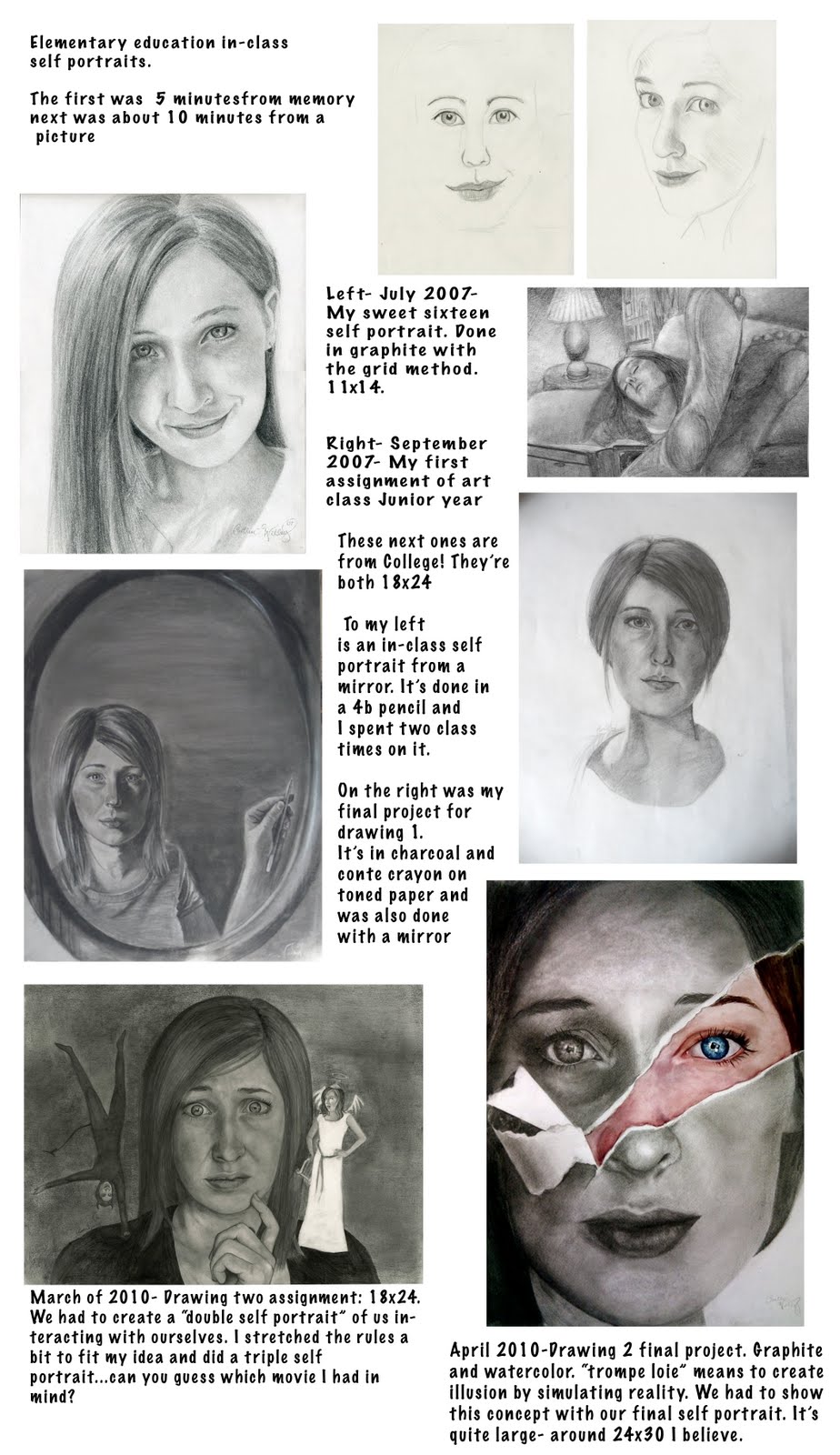
I remember attempting self portraits all growing up from memory, from mirrors, and from review mirrors on vacations. It wasn't until I was sixteen that I did a really respectable one using a photograph and grid method. In high school, I did a self portrait of me in a broken mirror (see slideshow), and a quick sketch of me falling asleep reading a textbook...which happened all too often! Then enter college. O MY. My first and last assignments of both my drawing classes were infamous self portraits, plus all the in class ones. When we were assigned to bring pictures of ourselves in El. Art Methods, I knew what was coming. Self portraits are a staple for art classes, why would this class be an exception?

This self portrait assignment taught us different methods of drawing which yielded different levels of accuracy. I already had a self portrait done via grid method, so I decided to turn that one in rather than do another one. Here's the two I did in class, and a myriad of other random recent- ish self portraits. (click to enlarge)